Art in Mesopotamian Visual Culture Enabled and Reflected Political Power True
Art is an essential aspect of any culture. Once the basic homo needs have been taken care of such as food, shelter, some grade of community constabulary, and a religious belief, cultures begin producing artwork, and often all of these developments occur more or less simultaneously. This procedure began in the Predynastic Period in Egypt (c. 6000 - c. 3150 BCE) through images of animals, human beings, and supernatural figures inscribed on stone walls. These early images were crude in comparison to later developments but still express an of import value of Egyptian cultural consciousness: remainder.
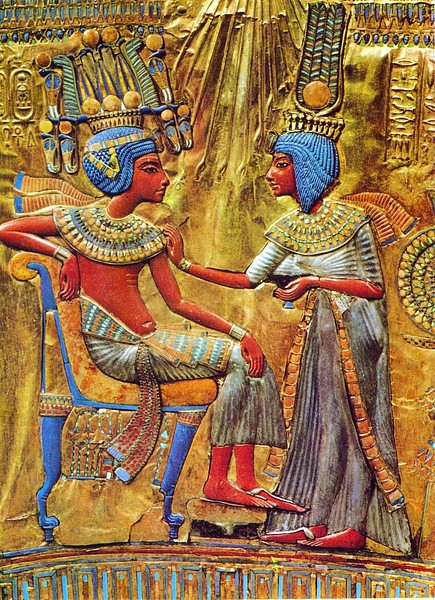
Tutankhamun & Ankhsenamun
Egyptian society was based on the concept of harmony known as ma'at which had come into existence at the dawn of creation and sustained the universe. All Egyptian art is based on perfect residual because it reflects the ideal globe of the gods. The same way these gods provided all good gifts for humanity, so the artwork was imagined and created to provide a use. Egyptian art was always first and foremost functional. No thing how beautifully a statue may have been crafted, its purpose was to serve every bit a abode for a spirit or a god. An amulet would have been designed to be bonny but aesthetic beauty was not the driving force in its creation, protection was. Tomb paintings, temple tableaus, dwelling and palace gardens all were created so that their grade suited an important role and, in many cases, this function was a reminder of the eternal nature of life and the value of personal and communal stability.
Early Dynastic Period Art
The value of balance, expressed as symmetry, infused Egyptian art from the primeval times. The rock fine art from the Predynastic Period establishes this value which is fully developed and realized in the Early Dynastic Period of Arab republic of egypt (c. 3150 - c. 2613 BCE). Art from this period reaches its meridian in the work known every bit The Narmer Palette (c. 3200-3000 BCE) which was created to celebrate the unity of Upper and Lower Egypt under Male monarch Narmer (c. 3150 BCE). Through a serial of engravings on a siltstone slab, shaped every bit a chevron shield, the story is told of the great king's victory over his enemies and how the gods encouraged and approved his actions. Although some of the images of the palette are difficult to interpret, the story of unification and the commemoration of the king is quite clear.
![Narmer Palette [Two Sides]](https://www.worldhistory.org/img/r/p/500x600/4412.jpg?v=1649972822)
Narmer Palette [Two Sides]
On the front, Narmer is associated with the divine force of the balderdash (perchance the Apis Bull) and is seen wearing the crown of Upper and Lower Egypt in a triumphal procession. Beneath him, ii men wrestle with entwined beasts which are oft interpreted as representing Upper and Lower Egypt (though this view is contested and there seems no justification for it). The opposite side shows the king's victory over his enemies while the gods look on approvingly. All these scenes are carved in low-raised relief with incredible skill.
This technique would be used quite finer toward the end of the Early on Dynastic Period past the architect Imhotep (c. 2667-2600 BCE) in designing the pyramid complex of King Djoser (c. 2670 BCE). Images of lotus flowers, papyrus plants, and the djed symbol are intricately worked into the architecture of the buildings in both loftier and low relief. By this time the sculptors had also mastered the art of working in stone to created iii-dimensional life-sized statues. The statue of Djoser is among the greatest works of fine art from this catamenia.
Old Kingdom Fine art
This skill would develop during the Old Kingdom of Egypt (c. 2613-2181 BCE) when a strong central regime and economical prosperity combined to allow for monumental works like the Keen Pyramid of Giza, the Sphinx, and elaborate tomb and temple paintings. The obelisk, first developed in the Early Dynastic Period, was refined and more widely used during the One-time Kingdom. Tomb paintings became increasingly sophisticated only statuary remained static for the most part. A comparison between the statue of Djoser from Saqqara and a small ivory statue of Male monarch Khufu (2589-2566 BCE) found at Giza display the same form and technique. Both of these works, withal, are exceptional pieces in execution and detail.
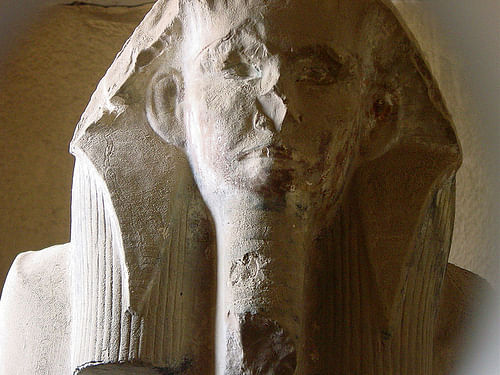
Djoser
Art during the Old Kingdom was country mandated which means the king or a high-ranking nobility commissioned a piece and too dictated its style. This is why there is such uniformity in Onetime Kingdom artwork: different artists may have had their ain vision simply they had to create in accordance with their customer'south wishes. This paradigm changed when the One-time Kingdom collapsed and initiated the First Intermediate Menstruation (2181-2040 BCE).
Art in the Commencement Intermediate Catamenia
The First Intermediate Period has long been characterized every bit a time of chaos and darkness and artwork from this era has been used to substantiate such claims. The argument from art rests on an estimation of First Intermediate Menses works as poor quality likewise as an absenteeism of awe-inspiring edifice projects to bear witness that Egyptian civilisation was in a kind of gratis fall toward chaos and dissolution. In reality, the First Intermediate Period of Arab republic of egypt was a time of tremendous growth and cultural change. The quality of the artwork resulted from a lack of a strong primal government and the corresponding absenteeism of state-mandated art.
The quality of the artwork resulted from a lack of a stiff central regime & the corresponding absence of land-mandated fine art.
The dissimilar districts were at present free to develop their ain vision in the arts and create co-ordinate to that vision. In that location is nothing 'low quality' nigh First Intermediate Period fine art; information technology is but unlike from Old Kingdom artwork. The lack of awe-inspiring building projects during this fourth dimension is also easily explained: the dynasties of the Former Kingdom had drained the government treasury in creating their ain grand monuments and, by the time of the 5th Dynasty, there were no resources left for such projects. The collapse of the Old Kingdom following the 6th Dynasty certainly was a time of confusion, but there is no evidence to suggest the era which followed was any kind of 'dark age'.
The First Intermediate Period produced a number of fine pieces merely also saw the rise of mass-produced artwork. Items which had previously been made past a single artist were at present assembled and painted past a production coiffure. Amulets, coffins, ceramics, and shabti dolls were amidst these crafts. Shabti dolls were of import funerary objects which were cached with the deceased and were thought to come to life in the side by side world and tend to one's responsibilities. These were made of faience, stone, or woods but, in the First Intermediate Menstruum, are mostly of forest and mass produced to be sold cheaply. Shabti dolls were important items because they would permit the soul to relax in the afterlife while the shabti did one's piece of work. Previously, only the wealthy could afford shabti dolls, just in this era, they were available to those of more pocket-size ways.
Middle Kingdom Art
The First Intermediate Period ended when Mentuhotep II (c. 2061-2010 BCE) of Thebes defeated the kings of Herakleopolis and initiated the Middle Kingdom of Egypt (2040-1782 BCE). Thebes now became the capital of Egypt and a strong key government over again had the power to dictate artistic sense of taste and creation. The rulers of the Middle Kingdom, however, encouraged the different styles of the districts and did not mandate that all art conform to the tastes of the nobility. Although in that location was great reverence for Sometime Kingdom art and, in many cases, an obvious endeavor to reverberate it, Middle Kingdom Art is distinctive in the themes explored and the composure of the technique.
The Middle Kingdom is unremarkably regarded as the loftier point of Egyptian culture. The tomb of Mentuhotep II is itself a work of art, sculpted from the cliffs near Thebes, which merges seamlessly with the natural landscape to create the effect of a wholly organic work. The paintings, frescoes, and bronze which accompanied the tomb also reflect a high level of sophistication and, as always, symmetry. Jewelry was also refined greatly at this fourth dimension with some of the finest pieces in Egyptian history dated to this era. A pendant from the reign of Senusret II (c. 1897-1878 BCE) which he gave to his daughter is fashioned of sparse gold wires attached to a solid gold backing inlaid with 372 semi-precious stones. The statues and busts of kings and queens are intricately carved with a precision and beauty defective in much of the Onetime Kingdom artwork.
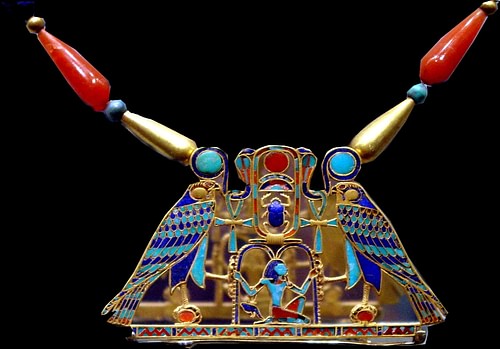
Pectoral of Senusret Ii
The nearly hit attribute of Heart Kingdom art, however, is the subject thing. Common people, instead of nobility, feature more than often in art from this period than any other. The influence of the First Intermediate Period continues to be seen in all the fine art from the Middle Kingdom, where laborers, farmers, dancers, singers, and domestic life receive virtually as much attending as kings, nobles, and the gods. Artwork in tombs continued to reflect the traditional view of the afterlife, but literature from the time questioned the onetime conventionalities and suggested that 1 should concentrate on the merely life one could be sure of, the nowadays.
This accent on life on earth is reflected in less idealistic and more realistic artwork. Kings like Senusret Iii (c. 1878-1860 BCE) are depicted in statuary and art as they really were instead of as ideal kings. Scholars recognize this by the uniformity and detail of the representations. Senusret III is seen in dissimilar works at different ages, sometimes looking careworn, sometimes victorious, whereas kings of earlier eras were always shown at the same historic period (young) and in the same way (powerful). Egyptian art is famously expressionless because the Egyptians recognized that emotions are fleeting and one would not want one'due south eternal epitome to reflect only one moment in life simply the totality of one'due south existence.
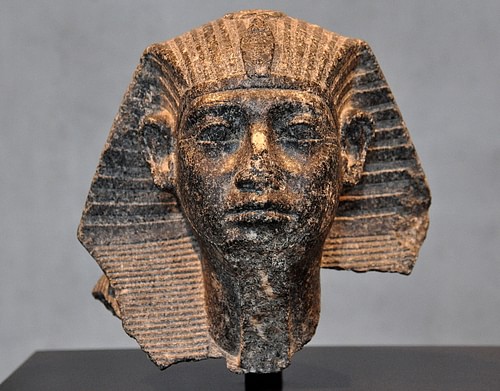
Head of Senusret III
The Eye Kingdom began to dissolve during the 13th Dynasty when the rulers had grown also comfortable and neglected the affairs of land. The Nubians encroached from the south while a foreign people, the Hyksos, gained a substantial foothold in the Delta region of the due north. The government at Thebes lost control of large sections of the Delta to the Hyksos and could exercise null about the growing power of the Nubians; it became increasingly obsolete and ushered in the era known as the Second Intermediate Period (c. 1782 - c. 1570 BCE). During this time the regime at Thebes connected to commission artwork just on a smaller scale while the Hyksos either appropriated earlier works for their temples or commissioned for grander works.
Second Intermediate Period/New Kingdom Art
The art of the Second Intermediate Period of Arab republic of egypt connected the traditions of the Middle Kingdom but often less effectively. The best artists were bachelor to the nobility at Thebes and produced high-quality work, but non-royal artists were less skilled. This era, similar the showtime, is also frequently characterized equally disorganized and chaotic, and the artwork held up as proof, but there were many fine works created during this time; they were simply on a smaller scale.
Tomb paintings, bronze, temple reliefs, pectorals, headdresses, and other jewelry of loftier quality continued to be produced and the Hyksos, though often vilified past later Egyptian writers, contributed to cultural development. They copied and preserved many of the written works of earlier history which are still extant and also copied statuary and other artworks.
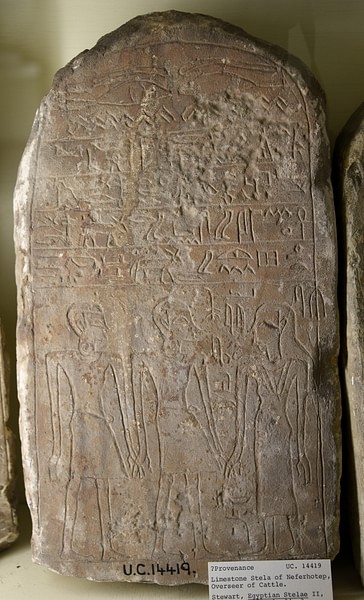
Egyptian Stela of Neferhotep
The Hyksos were finally driven out by the Theban prince Ahmose I (c. 1570-1544 BCE) whose dominion begins the menstruation of the New Kingdom of Egypt (c. 1570 - c. 1069 BCE). The New Kingdom is the near famous era of Egyptian history with the best-known rulers and well-nigh recognizable artwork. The jumbo statues which were initiated in the Middle Kingdom became more than mutual during this time, the temple of Karnak with its great Hypostyle Hall was expanded regularly, the Egyptian Book of the Expressionless was copied with accompanying illustrations for more and more people, and funerary objects similar shabti dolls were of higher quality.
Egypt of the New Kingdom is the Egypt of empire. Every bit the borders of the land expanded, Egyptian artists were introduced to different styles and techniques which improved their skills. The metalwork of the Hittites which the Egyptians made apply of in weaponry as well influenced fine art. The wealth of the country was reflected in the enormity of individual artworks besides as their quality. The pharaoh Amenhotep Iii (1386-1353 BCE) built so many monuments and temples that later scholars attributed to him an exceptionally long reign. Amongst his greatest works are the Colossi of Memnon, ii enormous statues of the seated male monarch ascent 60 ft (eighteen m) high and weighing 720 tons each. When they were congenital they stood at the entrance to Amenhotep III's mortuary temple, which is now gone.
Amenhotep Three'southward son, Amenhotep Iv, is better known as Akhenaten (1353-1336 BCE), the proper noun he chose later devoting himself to the god Aten and abolishing the ancient religious traditions of the country. During this time (known as the Amarna Period) art returned to the realism of the Heart Kingdom. From the beginning of the New Kingdom, artistic representations had again moved toward the ideal. During the reign of Queen Hatshepsut (1479-1458 BCE), although the queen is depicted realistically, most portraits of nobility evidence the idealism of Old Kingdom sensibilities with heart-shaped faces and smiles. The art of the Amarna period is so realistic that modern-day scholars have been able to reasonably suggest what concrete ailments people in the pictures probably suffered from.
Two of the most famous works of Egyptian art come from this fourth dimension: the bust of Nefertiti and the aureate decease mask of Tutankhamun. Nefertiti (c. 1370-1336 BCE) was Akhenaten's married woman and her bosom, discovered at Amarna in 1912 CE by the German archaeologist Borchardt is virtually synonymous with Egypt today. Tutankhamun (c.1336-1327 BCE) was Akhenaten'due south son (simply non Nefertiti'southward) who was in the process of dismantling his begetter'due south religious reforms and returning Arab republic of egypt to traditional beliefs when he died before the age of 20. He is best known for his famous tomb, discovered in 1922 CE, and the vast number of artifacts information technology contained.
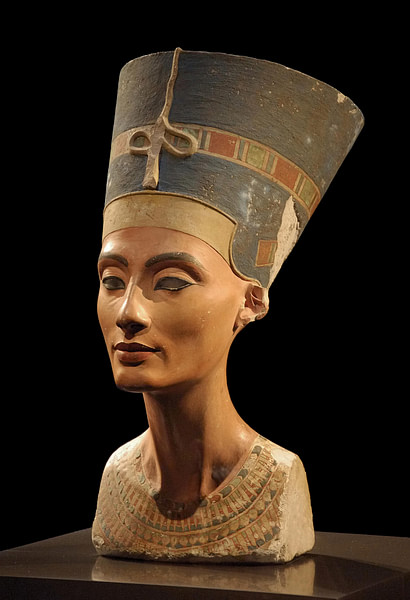
Queen Nefertiti
The golden mask and other metallic objects constitute in the tomb were all the event of innovations in metalwork learned from the Hittites. The art of the Egyptian Empire is among the greatest of the civilization because of the Egyptian'south interest in learning new techniques and styles and incorporating them. Prior to the arrival of the Hyksos in Arab republic of egypt, Egyptians thought of other nations as barbaric and uncivilized and did not consider them worthy of any special attention. The Hyksos 'invasion' forced the people of Egypt to recognize the contributions of others and make employ of them.
Afterward Periods & Legacy
The skills caused would go on through the 3rd Intermediate Period of Egypt (c. 1069-525 BCE) and Tardily Period (525-332 BCE), which are also negatively compared with the grander eras of a strong primal regime. The style of these later periods was affected past the times and the limited resource, merely the art is still of considerable quality. Egyptologist David P. Silverman notes how "the art of this era reflects the opposing forces of tradition and modify" (222). The Kushite rulers of the Late Period of Ancient Egypt revived Old Kingdom fine art in an endeavor to identify themselves with Egypt'southward oldest traditions while native Egyptian rulers and dignity sought to accelerate artistic representation from the New Kingdom.
This same paradigm holds with Persian influence following their invasion of 525 BCE. The Persians also had great respect for Egyptian culture and history and identified themselves with Erstwhile Kingdom fine art and architecture. The Ptolemaic Period (323-30 BCE) blended Egyptian with Greek art to create statuary similar that of the god Serapis - himself a combination of Greek and Egyptian gods - and the fine art of the Roman Egypt (30 BCE - 646 CE) followed this same model. Romans would depict on the older Egyptian themes and techniques in adapting Egyptian gods to Roman understanding. Tomb paintings from this time are distinctly Roman but follow the precepts begun in the Sometime Kingdom.
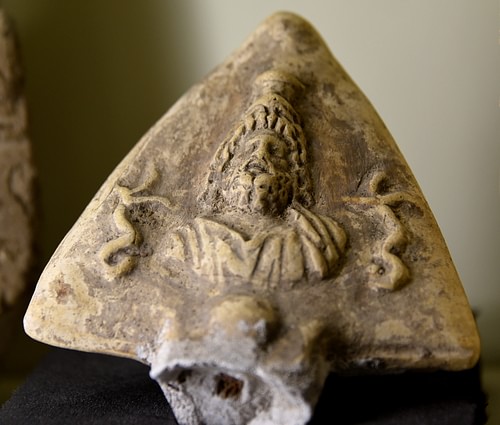
Egyptian Oil Lamp with Serapis
The art of these later cultures would come to influence European understanding, technique, and style which would be adhered to for over 1,000 years until artists in the late 19th century CE, such as the Futurists of Italy, began breaking with the past. So-chosen Modern Art in the early 20th century CE was an effort to force an audience to see traditional subjects in a new light. Artists like Picasso and Duchamp were interested in forcing people to recognize their preconceptions about fine art and, by extension, life in creating unexpected and unprecedented compositions which broke from the past in style and technique. Their works and those of others were only possible, however, considering of the paradigm created by the ancient Egyptians.
This article has been reviewed for accuracy, reliability and adherence to academic standards prior to publication.
Source: https://www.worldhistory.org/article/1077/a-brief-history-of-egyptian-art/

Post a Comment for "Art in Mesopotamian Visual Culture Enabled and Reflected Political Power True"